Which of the following statements is not part of Dalton's Atomic Theory?
1. Different elements will have atoms of different masses.
Correct! According to Dalton's atomic theory, each element has its own unique mass; therefore, the atoms of one element would have a different mass compared to the atoms of another element.
2. Atoms cannot be created nor destroyed.
Correct! According to Dalton's theory, the atom is the smallest unit of nature and cannot be broken down any further.
3. When a substance or multiple substances react through a chemical change, the atoms rearrange to form new substances.
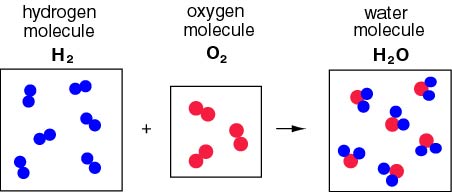
Correct! Similar to the statement in choice 2, atoms cannot be created or destroyed during any chemical changes; therefore, during a chemical reaction, the atoms can only rearrange to form different combinations of elements. For example, when hydrogen is burnt in the presence of oxygen, the hydrogen atoms and the oxygen atoms rearrange to form molecules of water, as shown below.
4. Atoms of the same element can have different masses.
Incorrect! According to Dalton's atomic model, all atoms of the same element are identical; however, as we will see, this tenet of his theory is no longer supported.
5. Compounds must always have the same ratio of atoms present. If this ratio changes, the identity of the compound changes.
Correct! As you see in the diagram above, in order to form a molecule of water, 2 hydrogen atoms must combine with 1 atom of oxygen. This 2:1 ratio of hydrogen to oxygen must be maintained in order for the compound to be considered water (H2O). Just by adding one more oxygen to the mix, the properties of the compound changes completely. The 2 hydrogen to 2 oxygen ratio would form hydrogen peroxide (H2O2) instead of water, which is the chemical that people use to disinfect wounds. As you can see, each compound will have its own unique ratio of atoms with its own special chemical formula used to represent that ratio; the chemical formulas for water and hydrogen peroxide are shown above in parentheses. Each element has its own unique one or two letter symbol which is used when writing chemical formulas. These symbols can be found on the Periodic Table of Elements. The chemical formula also use subscripts: the subscripts (the tiny numbers written to the lower right of the element's symbol) represent the number of atoms of each element found in the substance.